Maintain your medication adherence using the CareClinic medicine tracker. CareClinic is a Mobile App designed to help take action on your health and more specifically your medication. Tracking all of the medicines you take will help you maintain an accurate representation of your health. This will prove to be useful especially when you are going through a treatment.
Do you need to use a Medicine Tracker?
 Yes! Here’s why you should track your medication intake.
If you are taking multiple medications it gets hard to remember why you take certain medications. It also gets complicated when you might have multiple medications for multiple different reasons or illnesses. You should be aware of the medication you take and why exactly you take it. Your family members or friends should also be aware of the medication you are taking in case of emergencies.
Personal Record
You must track your medication to ensure you see the progress of your treatments and maintain a personal record to see the improvement of your illness. This will also help you determine if you are experiencing any side effects as a result of the pills or medication you are taking. If you are starting new medications you should track it to see if any side effects appear and track information your doctor gave you about what to do in case of an emergency. This will especially help your caregivers in case of an emergency.
Tracking your medication can be made easy using a mobile app because it will allow you to input the medicine name, and your doctors’ names. In addition, you can input the doses and other information like instructions.
Specifications
Some medications should be taken while consuming food or on an empty stomach. Tracking this information becomes increasingly important as the number of medications you are taking increases. You can also track information about what you should do in case you miss a dose, this will ensure that your treatment is highly effective.
Tracking medication that you do not regularly take will allow you to ensure that you are not consuming expired medications. Expired medications can be less effective. In some cases even risky in certain situations so please communicate with your health professional when contemplating expired medications. On top of tracking your expired medication, it will also inform you when you are running low on your medications. This will allow you to plan your refills.
Medication Tracking using the Mobile App
Tracking Medication should not be a difficult task, however, it can become extremely difficult if one is suffering from a chronic condition or if one is trying to figure out what health modalities can help improve performance. Using a Medicine Tracker app can greatly improve your adherence.
CareClinic does an exceptional job is providing all the tools necessary to stay sane when dealing with a treatment plan no matter how complex. CareClinic even has different brand choices for certain medicines that you might track. This will improve the accuracy of your record. Using a medicine tracker that is on your phone also allows you to keep a pocket diary of your health. If you are someone always on the go having a medicine tracker will be useful in case of an emergency.
CareClinic begins by having user’s build a care plan which can include medications, natural ailments, and any other health solution that the user is engaging in for their health. Your treatment may include external factors like maintaining a healthy fitness activity level. You can easily use our Fitness Tracker to track your fitness in addition to your medicine tracker.
Tracking Your Heart Medications
If you have recently had a heart attack you might be prescribed types of heart medications for the rest of your life. In addition to medication, you might also be asked to partake in more fitness activities and eat healthier foods. Your doctor will advise you on your specific condition to ensure that you maintain a healthy life.(R)
CareClinic can help you with your heart problems with our Fitness Tracker and Nutrition Tracking features. Tracking your fitness is important when you are recovering from heart conditions in order to get your energy and strength back. Aerobic and strength exercises are excellent for your heart, but it may be challenging in the beginning. Start tracking your fitness to see your improvements and watch you achieve your goals.
Nutrition tracking is important as well but it can be difficult and time-consuming. Use CareClinic to easily track your food intake in the same place as your medicine tracker and fitness tracker. Tracking your food consumption can help you determine if it’s your diet that is making you sluggish or if it’s your new medication. In addition, if you recently started tracking your nutrition to improve your heart health it might be hard for you to determine if you are eating a balanced diet.
Manage Your Anti-Nausea Medications
Anti-nausea medicines may be given to you before treatments like chemotherapy or radiation therapy. They might be taken many hours or even a few days prior to treatment and you can easily track these in the CareClinic app. You can easily search the specific anti nausea medication you are taking and its dosage to track it.
It is advised that you take them as prescribed by your healthcare team. If this is a new medicine you are consuming you should be tracking it to see if you experience any side effects, especially if it is a new medication you are trying.
Here are the top benefits of using the CareClinic App:
- Add as many medicine and Supplements as needed
- Get notified if there are interactions* or synergies
- Add Therapy, Activity, Nutrition that will aid in your health goal
- Quickly set reminders for any of the above modalities
- Integrate with any wearables if needed
- Mark your reminders as “Taken” or “Skip” them as needed
- Get periodic reminders for refills, and or from your careteam
- Log any one-time-medications (PRN’s) as needed
- View reports and correlations by yourself or share them with your care provider.
Maintain Medication Adherence
Maintaining a daily routine has many benefits for individuals, it ensures that you are taking your medications at the right times. It might also help make taking medications less stressful by incorporating it into your daily activities.
Most people who don’t have any type of routine suffer from stress, poor eating behaviours and poor physical conditions. Without a daily routine especially with your consumption you might have an unhealthy diet. Having an unhealthy diet may be a contributor for your medications, if that is the case you can use CareClinic as a nutrition tracker as well.
Routines can be fun and exciting as well, they have helped many improve their overall health. It has become increasingly important for your physical and mental health during stressful times like the Covid-19 Pandemic.
Practice better #self-care
The benefits of making a care plan:
– Quickly see everything that needs to be taken and what which dose
– Includes other modalities like: Therapies, Physical Activity, Nutrition
– Helps record start/end dates for each, once clicked
– Medicine Tracker which helps manage your reminders for each medication
The Care Plan is great if you add Care Givers to the App, as they can quickly get an idea as to what you take, and at what dose.
The Care Plan also helps populate the Check-In screen where you can check-in to different activities in your care plan to record when you consumed medication or engaged in physical activity.
What Can You Track
It might be a great idea to start a healthy physical activity challenge with your friends and family to see who can perform the most physical activity in a week. Starting a healthy competition for your medicine tracking could also be a great way to feel like you are all on a team together.
It is a great place to also journal your progress if needed or record measurements related to your health, such as: Sleep, Blood Pressure, and Energy levels.
You may access all functionality through the mobile app at any time.
If you are offline, the app will sync automatically when you connect online, this is the only reason you need to create an account.
Determine Success
CareClinic prepares reports for you determined by the highly protected data you provide through your entries. Looking at these reports will help you understand how far you have come in your health journey. These reports will be beneficial for you to go through with your health professional to see if your treatments and medications are working. The reports feature can also determine if there are any correlations between your medications and your feelings or behaviour.
Using this medicine tracker will help you determine which medications are giving you the best treatments and which are not. Maybe you decided to jump between brands, medicine tracking will help you determine which medications work best for you. This will be a great contributor if there is a large difference in price of the medicine.
If you recently went through a heart problem and are taking heart medications you might be trying to incorporate a healthier lifestyle. Tracking your success will be a large motivator. Maintaining a healthy lifestyle isn’t easy, but it can be made easier using CareClinic. It is your pocket medicine file ready to be your personal medicine tracker and empower your health.
Your Care Team
As mentioned above you can easily add your family members or friends to your Care Team. This will allow them to see that you have taken your medication and track it with you. Having a support team is important especially if you are going through a mentally challenging treatment. Maintaining a healthy competition between your loved ones will be a great way to keep everyone engaged and healthy at the same time.
Communicating about your health with friends and family might not always be comfortable. Adding your loved ones to your Care Team helps ease that tension. For example, if you know someone who has cancer and as a result has to take multiple different medications. It might not be easy to talk about it all the time. It will be easier for you to just get a notification that they took their medicine instead of you knocking on their door everyday.
Avoid Constant Check-Ins
If you have an elderly member in your family who does not live with you, it would be ideal for you to add them to your Care Team. This will allow them to have independence. In addition, you won’t have to worry about whether or not they forgot to take their medication. This is especially beneficial to elderly individuals that take multiple medications at various times.
Let us look at this through an example. Penelope is a young 21-year-old who was recently diagnosed with depression. An aspect of her treatment is that she has to take anti-depressants. Penelope has many family members that want to help her and see her progress through the days. By including her family members and friends in her Care Team, she is able to keep them in the loop. But this allows her to maintain some privacy without having consistent conversations about her health. This helps her loved ones feel that she is safe and it helps her recover from her mental illness.
As mentioned above, you can easily motivate your Care Team to contribute more fitness or a healthier lifestyle. Having a healthy competition to see who can walk the most steps might be a great way to make sure everyone you care about is staying active. This will be even more helpful during quarantine measures.
Medication Reconciliation
A medication reconciliation is a formal process where healthcare providers communicate and work with patients, families and care providers to accumulate and create comprehensive medication information. Use CareClinics medicine tracker to help add to your medication reconciliation. Having it on your phone ensures that this information is with you almost always. Also, having your family members or caregivers allows them to have access and to see your Care Plan.
Knowledge is the best medicine and maintaining this knowledge about your medicine and health is important. Empower your health by maintaining your personal health records and personal symptoms. If you maintain regular check ups with your health professionals using a medicine tracker will help you. You can easily remember and address your issues making it a quick appointment.
Managing your Medicine Timing
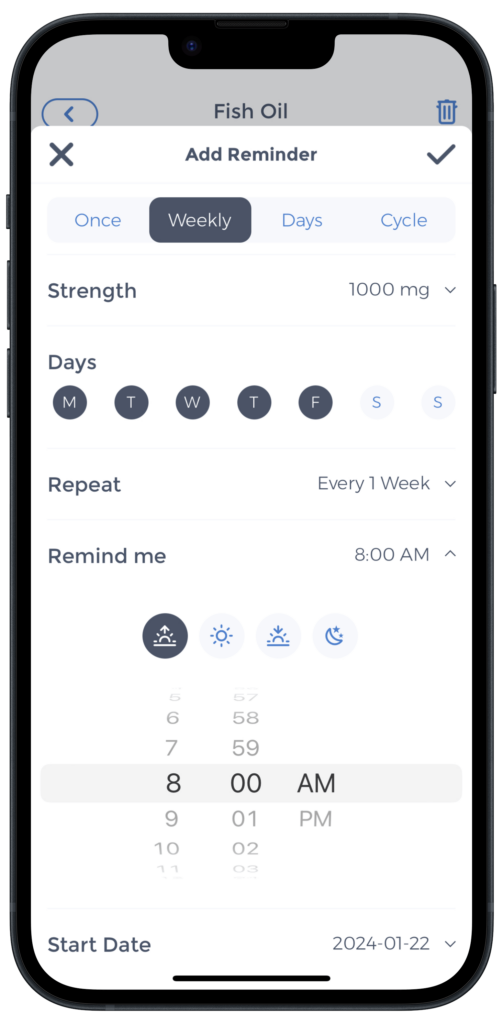
Tracking medication is the most basic of features of CareClinic, you may choose the type of medication, the color, the dose, the purpose, the side effects, the effectiveness when starting out. See the screenshot on the side to get a sense of how it looks on the web.
From here you can proceed to set reminders for each individual item in your care plan or you may set an overall reminder to follow your Care Plan.
The reminders can be personalized in any way needed. Additionally, we also have other reminders that can be set:
- Refill Reminders – Alerts you if you will need a refill
- CareTeam Reminders – Alerts Caregiver if you have problems
- Therapy, Activity, Nutrition Reminders
- Along with: Individual Reminders for each drug or supplement
- Entire Care Plan Reminders – Alerts you to follow your care plan
Over the Counter Medicine
With the increasing cost of medications and visits to doctors, you might be self-medicating. As a result of self medicating you might be using over the counter medications. Over-the-counter drugs are more convenient and more economical. However, general practitioners are sceptical about the safety and value of these medications.(R) Using a medicine tracker will help you control and maintain records of your medicines, which will prove to be useful if anything goes wrong.
Using a medicine tracker to maintain a record of these drugs will be necessary when you go to a health professional. This will help them update their records as well so that it is on your medical records. Maintaining an accurate medical record is essential to monitoring the effectiveness of your treatments, screening, and education.
Using the Medicine Tracker
You can track all the medication you need to take through the main screen and you can mark them as taken there as well. Please see the screenshots below to see how we enable you to track and manage your medication more easily.
There are many other tools you can use within CareClinic to make medication tracking easier. CareClinic was designed to help you make the right health decisions and the right time, it is much more than a medicine tracker app! To learn more about how CareClinic can help you manage your health better, click to see all the features.
You may download the app for iOS (Apple App Store) and Android (Google Play Store).
*CareClinic does it’s best to notify you of as many interactions as possible. However, it is not a replacement for professional medical advice.